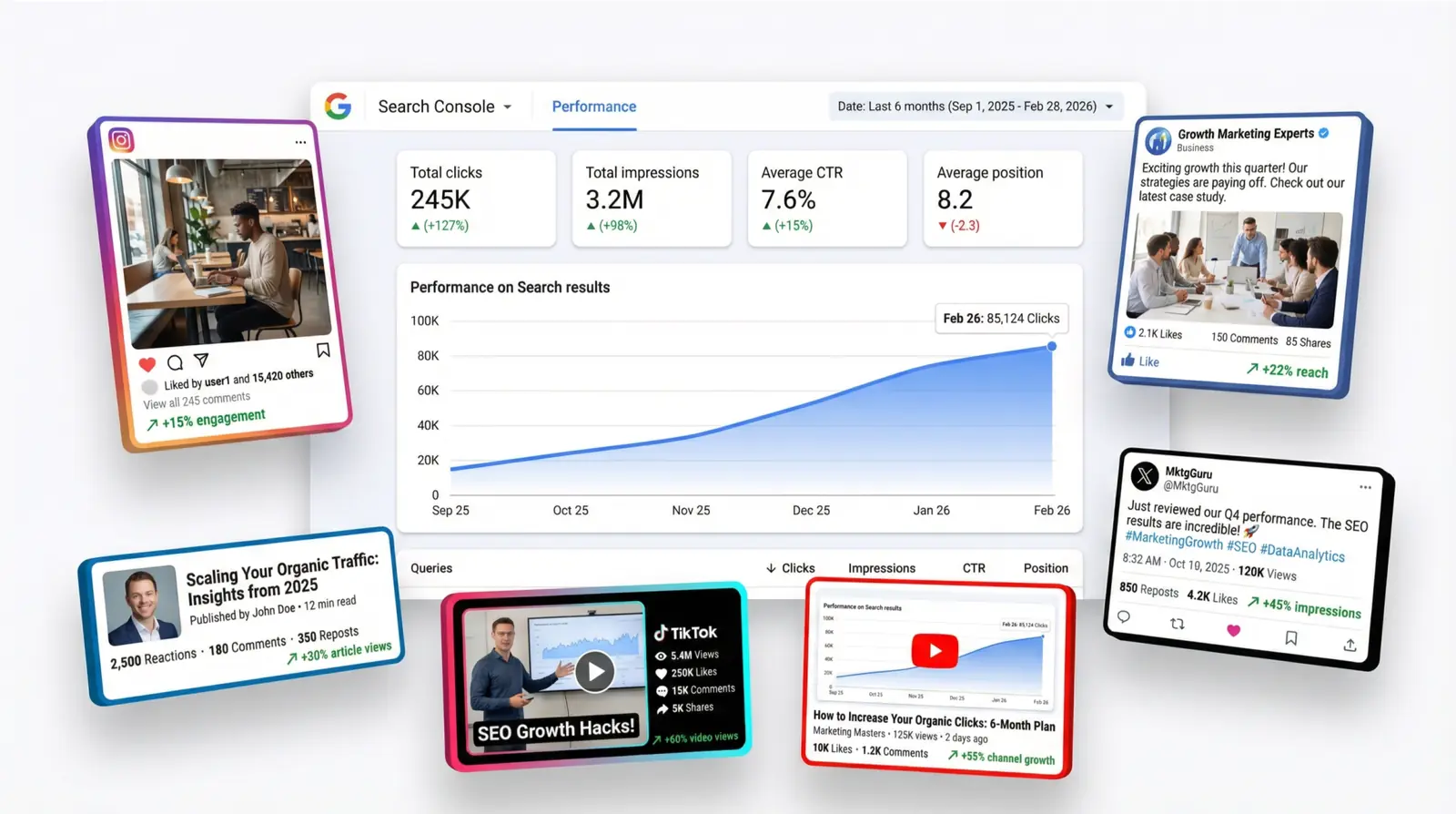
- A strong SEO report tracks 7-9 metrics maximum, tied directly to the client’s business goals, not vanity numbers.
- The three things clients actually want from SEO reporting: proof that the investment is working, clarity on what happens next, and confidence that someone competent is in charge.
- In 2026, SEO reports should include AI visibility metrics alongside traditional organic performance, as 63% of agencies have already changed their KPIs to reflect how AI Overviews are reshaping search.
- Agencies that set realistic KPIs during onboarding and report against them consistently achieve 15-20 percentage points better retention than industry averages.
- Monthly reporting is the standard, but the report itself matters less than the narrative it tells. Data without context is noise.
SEO reporting is the most underleveraged retention tool in agency work. The average SEO agency sees 38% annual client churn, and the leading cause is not poor results. It is communication breakdown. Clients leave because they do not understand what is happening, whether progress is real, or what their money is producing. The report is where that gap either closes or widens.
Most SEO reports fail because they are built for the agency, not the client. They dump rankings, traffic graphs, and technical jargon into a PDF that nobody reads past page two. The result: clients feel uninformed, question the investment, and start shopping for alternatives.
What Is SEO Reporting (and Why Most Reports Fail)?
SEO reporting is the process of collecting, analyzing, and presenting search performance data in a format that shows progress, explains results, and recommends next steps. It is not a data dump. It is a communication tool that bridges the gap between technical execution and business outcomes.
The difference between tracking and reporting matters. Tracking is the day-to-day monitoring of keyword positions, clicks, and crawl errors. Reporting takes that data and turns it into a narrative: what changed, why it changed, and what to do about it. Most agencies confuse the two, which is why most reports fail.
Three reasons SEO reports fail:
- Data without context. A table showing 47 keyword movements means nothing to a CEO. Without explaining which movements matter and what they mean for revenue, the report is noise the client will stop reading.
- Metrics disconnected from goals. Reporting on domain authority, crawl stats, and backlink counts when the client’s goal is lead generation creates a trust gap. The client sees activity but not progress toward their actual objective.
- No clear next steps. A report that ends with charts but no recommendations tells the client you are monitoring, not managing. Every report should answer: what did we do, what happened, and what are we doing next.
The hidden cost: Agencies spend 4-8 hours per client creating monthly reports manually, pulling data from multiple sources and formatting charts. That time adds up fast. But the bigger cost is not the hours. It is the client who cancels because the report never made them feel confident in the work.
The 7 Core Metrics Every SEO Report Should Track
Best practice is to include no more than 9 metrics in a client report. Beyond that, comprehension drops and the client disengages. These seven form the foundation for most engagements. Adjust based on the client’s specific goals.
- Organic traffic (sessions from search). The baseline metric that shows whether SEO is driving more people to the site. Report month-over-month and year-over-year to separate real growth from seasonal patterns. Pull this from Google Analytics 4, filtered to organic search only.
- Keyword rankings (movement and distribution). Do not list every keyword. Instead, report on three tiers: priority keywords tied to revenue pages, keywords that moved into the top 10 (new opportunities), and keywords that dropped significantly (risks to address). Distribution charts showing how many keywords sit in positions 1-3, 4-10, and 11-20 tell a clearer story than individual position tracking.
- Organic conversions (leads, sales, or signups from search). This is the metric clients care about most. Connect organic traffic to actual business outcomes using GA4 conversion tracking. If the client is an e-commerce brand, report revenue from organic sessions. If they are B2B, report form submissions and demo requests attributed to organic.
- Click-through rate (CTR) by page and query. CTR reveals whether your titles and meta descriptions are compelling enough to earn clicks from search results. A page ranking in position 3 with a 1.2% CTR has a content problem. A page in position 8 with a 6% CTR has momentum worth investing in. Pull this from Google Search Console.
- Technical SEO health. Report on Core Web Vitals (LCP, CLS, INP), crawl errors, indexation status, and site speed. Clients do not need every detail, but they need to know the site is technically healthy. Frame technical SEO health as the infrastructure that supports everything else. A single chart showing the percentage of pages passing Core Web Vitals is enough for most clients.
- Backlink profile (new, lost, and quality). Report the number of new referring domains acquired, any significant links lost, and the average authority of new placements. Clients do not need a full backlink audit every month. They need to know their authority is growing and their link profile is healthy.
- Top-performing pages (traffic and conversions). Highlight the 5-10 pages driving the most organic traffic and conversions. This shows the client which content assets are working and where to double down. It also reveals patterns: what topics, formats, and page types generate the best results.
Should Your SEO Report Include AI Visibility Metrics?
Yes, and increasingly so. In 2026, search is no longer just Google’s ranked results. ChatGPT, Perplexity, Google AI Overviews, and other AI platforms are answering the same queries your SEO targets. If your reports ignore this channel, you are giving clients an incomplete picture.
Add an AI search visibility section to your monthly report. Track AI citation rate (how often your client’s brand appears in AI-generated answers for target queries), share of voice relative to competitors, and which pages AI platforms cite most. Even a simple before-and-after snapshot across 10-20 priority queries gives clients visibility into a channel most competitors are not measuring yet.
What Clients Actually Want From SEO Reports
There is a persistent gap between what agencies report and what clients want to see. Most agencies report activity. Clients want outcomes. Closing this gap is the single highest-leverage improvement you can make to your reporting.
| What Agencies Typically Report | What Clients Actually Want |
| 47 keyword ranking changes | Are we ranking for the terms that drive revenue? |
| Organic sessions increased 12% | Did more people contact us or buy from us this month? |
| 14 new backlinks acquired | Is our authority growing relative to competitors? |
| Core Web Vitals scores improved | Is our website working properly for visitors? |
| List of completed tasks this month | What are you doing next and why? |
Clients want three things from every report:
- Proof the investment is working. Connect SEO metrics to money. Traffic growth matters only when you show it drove more leads, sales, or pipeline. If you cannot draw a line from your work to their revenue, the report has not done its job.
- Clarity on what happens next. Every report should end with a clear plan: what you will do in the next 30 days, what you expect to happen, and what the client needs to provide. This eliminates the “so what?” feeling that kills client confidence.
- Confidence that someone competent is in charge. The report is a trust signal. Clean formatting, consistent structure, plain language, and honest commentary on both wins and challenges tell the client they are in good hands.
Example: Adobe Express. When reporting on a 12-month SEO engagement for Adobe Express France, the metrics that mattered to the client were simple: monthly visitors grew from 431,000 to 724,000 (+70%), SEO-driven sales grew from 862 to 1,448 per month (+68%), and 500 content pieces were optimized. Those three numbers told the entire story. The client did not need a 30-page deck. They needed proof that the system was working, framed in language they could share with their own leadership.
How to Structure an SEO Report That Gets Read
Structure determines whether a report gets read or skimmed and forgotten. Use a consistent five-section framework that moves from high-level summary to detailed metrics to next steps. The client should be able to stop reading after section one and still understand the state of their SEO.
- Executive summary (one page maximum). Open with the 3-5 most important numbers: organic traffic change, conversion change, top keyword wins, and any significant risks. Write this section last, after you have analyzed all the data. Use plain language. If a CEO cannot understand this page in 60 seconds, rewrite it.
- Traffic and conversion performance. Show organic sessions, conversion volume, and revenue impact with month-over-month and year-over-year comparisons. Use line charts for trends and highlight anomalies. If traffic dipped, explain why before the client has to ask.
- Keyword and content analysis. Report on keyword distribution shifts, top-performing pages, and new ranking opportunities. Include a short section on content published or optimized during the period. If you ran an SEO audit that month, summarize the key findings and what was fixed.
- Technical health and backlink summary. One chart for Core Web Vitals pass rate. One chart for indexation status. One summary of backlink acquisition (new referring domains, average authority). Keep this section short unless there are critical issues.
- Next steps and recommendations. End every report with a clear action plan for the coming month. List 3-5 priorities, explain the expected impact of each, and note anything you need from the client. This is the section that separates a report from a dashboard. Dashboards show data. Reports drive decisions.
How Often Should You Send SEO Reports?
Monthly is the standard for most engagements. It provides enough data to identify trends without overreacting to short-term fluctuations. Weekly reporting works for high-intensity sprints or launch periods, but it creates noise for ongoing retainers. Quarterly reports are useful as strategic reviews layered on top of monthly reports, covering longer-term trends, competitive shifts, and strategic pivots.
Whatever cadence you choose, consistency matters more than frequency. A report that arrives on the same day every month, in the same format, builds a rhythm the client comes to rely on. Missed or inconsistent reports signal disorganization, even if the work itself is strong.
How to Turn Reporting Into a Retention System
Reporting is not a deliverable. It is the mechanism that keeps the client relationship alive. Agencies that treat reporting as an afterthought experience higher churn, shorter contracts, and constant pressure to justify their fees. Agencies that treat reporting as a strategic tool retain clients longer and charge more.
Three principles turn reporting from a chore into a retention engine:
- Set KPIs during onboarding, not after the first month. Agencies that establish realistic, measurable KPIs before work begins achieve 15-20 percentage points better retention. The report then becomes a progress check against agreed goals, not a defensive exercise.
- Report on both wins and challenges honestly. Clients do not expect perfection. They expect transparency. A report that only shows positive metrics feels like a sales pitch. A report that acknowledges a traffic dip, explains why it happened, and shows the plan to fix it builds trust faster than any graph.
- Tie every metric to the client’s business language. If the client runs an e-commerce store, report in revenue. If they run a B2B SaaS company, report in leads and pipeline. If they run a local business, report in calls and bookings. Mirror their vocabulary, not yours.
Example: Bitrix24. For a B2B SaaS client, the most important monthly reporting metric was lead volume from organic search. Over 12 months, Awilix grew Bitrix24 France’s SEO-driven leads from 42 to 80 per month (+90%), with organic traffic increasing +95% and Top 10 keywords doubling (+102%). The monthly report anchored on that single number, leads, with supporting context on traffic, rankings, and content velocity. The client never questioned the value of the engagement because the report spoke their language: pipeline.
If your reports are not tied to a system that moves numbers, the reports are just decoration. Awilix builds SEO systems built for ROI where reporting and execution feed each other, so clients see the connection between what you do and what they get.
Reporting in 2026: What Has Changed
SEO reporting is not the same discipline it was two years ago. Four shifts require updates to your reporting framework:
- AI visibility is now a reportable metric. 63% of agencies have already changed their SEO KPIs to account for AI Overviews, ChatGPT citations, and zero-click search behavior. If your reports do not include an AI visibility section, you are behind the curve. Use an AI SEO audit framework to establish a baseline, then track AI citation changes monthly.
- Zero-click behavior changes what “success” looks like. When 58% of searches end without a click, reporting only on traffic misses half the story. Include impressions, SERP feature appearances, and brand visibility in AI-generated summaries. A page that appears in an AI Overview may drive zero clicks but massive brand awareness.
- GA4 is now the default analytics platform. Universal Analytics is gone. Reports should pull from GA4’s event-based model, using explorations and custom reports for deeper analysis. If you have not rebuilt your reporting templates around GA4, you are working with an outdated data foundation.
- Clients expect AI-related context. 37% of agencies cite client ROI doubts as a pricing barrier, partly driven by the perception that AI is replacing SEO. Your report is the place to address this directly. Show clients how traditional organic and AI visibility work together, and why both channels require investment.
The bottom line: A 2024-era SEO report that covers traffic, rankings, and backlinks is no longer sufficient. In 2026, reporting must cover organic performance, AI visibility, revenue impact, and a forward-looking action plan in one coherent view. The agencies that adapt their reporting first will retain clients longer and justify higher fees.
If your current reporting does not cover AI visibility, traditional organic performance, and revenue impact in one view, there is a gap worth closing. Start with a conversation about what your reports should look like and what they are missing.
Frequently Asked Questions
How long should an SEO report be?
Most effective SEO reports are 3-8 pages, depending on the complexity of the engagement. The executive summary should fit on one page. Detailed metrics and analysis should take 2-5 pages. The action plan and next steps should fit on one page. If your report exceeds 10 pages, you are likely including data that does not serve the reader. Prioritize clarity over comprehensiveness. A concise report that gets read beats a thorough report that gets ignored.
What is the difference between SEO tracking and SEO reporting?
SEO tracking is the ongoing, day-to-day monitoring of metrics like keyword positions, crawl errors, traffic changes, and backlink movements. It happens inside tools like Google Search Console, Ahrefs, or Semrush. SEO reporting takes that raw tracking data and turns it into a structured narrative: what changed since the last report, why it changed, what it means for the business, and what actions to take next. Tracking is for the team doing the work. Reporting is for the stakeholders making decisions.
How do you explain SEO results to non-technical clients?
Use business language instead of SEO jargon. Replace “organic sessions” with “visitors from Google.” Replace “referring domains” with “other websites linking to yours.” Connect every metric to an outcome the client cares about: leads, sales, calls, or bookings. Use simple before-and-after comparisons (last month vs. this month, this year vs. last year). If a metric requires a paragraph of explanation to make sense, it probably does not belong in a client-facing report.
What tools are best for SEO reporting in 2026?
The essential data sources are Google Search Console (rankings, impressions, CTR), Google Analytics 4 (traffic, conversions, user behavior), and a rank tracking tool like Ahrefs or Semrush (keyword distribution, backlink monitoring, competitor analysis). For presentation, Google Looker Studio is free and flexible for live dashboards. Tools like DashThis, Reporting Ninja, and AgencyAnalytics offer automated, white-labeled report generation for agencies managing multiple clients. For AI visibility tracking, tools like Ahrefs Brand Radar and SE Ranking’s AI Search add-on are emerging as industry standards.
Should you report on competitor SEO performance?
Include a competitor section only when it adds strategic context. Showing the client that a competitor gained 200 keywords in their space creates urgency. Showing that the client outpaces competitors on key terms builds confidence. Keep it focused: 1-2 competitors, tracked against 5-10 priority keywords, with a note on any significant movements. Do not include a full competitive audit every month. Reserve deeper competitor analysis for quarterly strategic reviews where the data can inform planning, not just observation.